
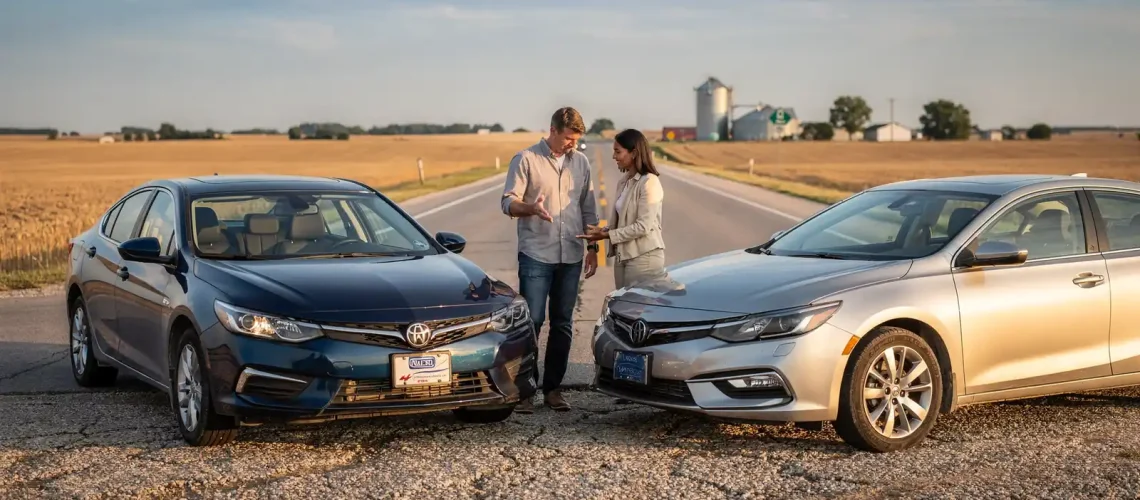
Kansas is a no-fault state. Every auto policy must include personal injury protection (PIP), which pays your medical bills and part of your lost wages after a crash, regardless of fault. You can claim against the at-fault driver for losses PIP does not cover, and for pain and suffering once your injuries meet the threshold in K.S.A. 40-3117. Under modified comparative fault, you recover nothing if your share of fault is equal to or greater than the other driver’s.
Key Takeaways
- Kansas is a no-fault state. Your own personal injury protection (PIP) coverage pays your medical bills and part of your lost wages, regardless of fault.
- PIP covers medical expenses, a portion of lost wages, and essential services like childcare or housekeeping, up to your policy limits.
- You can claim against the at-fault driver for losses PIP does not cover. A claim for pain and suffering requires meeting the injury threshold in K.S.A. 40-3117.
- Under Kansas modified comparative fault (K.S.A. 60-258a), you recover nothing if your share of fault is equal to or greater than the other driver’s.
Is Kansas a no-fault state?
Kansas is a no-fault state for car accidents. After a crash, you turn to your own auto policy to pay your medical bills, no matter who caused it. The idea is speed: your treatment gets paid for without waiting on anyone to sort out who was to blame.
The no-fault rules come from the Kansas Automobile Injury Reparations Act (K.S.A. 40-3101 et seq.), which requires every Kansas auto policy to include personal injury protection, usually called PIP. PIP is first-party coverage, meaning your own insurer pays a fixed set of accident-related expenses without regard to fault. In practice, your insurer covers your early medical costs and a portion of your lost wages up to your policy limits, so you are not chasing the other driver’s carrier for those first dollars.
Who does Kansas PIP cover?
PIP covers the person named on the policy, relatives who live in the same household, and passengers in the insured vehicle. Pedestrians struck by the insured vehicle also qualify in many cases. The coverage follows you and your household members whether you are driving, riding as a passenger, or hit while on foot. The expenses it pays for are listed further down.
Does no-fault mean I cannot sue the other driver?
No. No-fault decides whose insurance pays first. In Kansas, PIP is mandatory and partially replaces your right to sue the at-fault driver for the same expenses, but you keep the right to claim against a negligent driver for losses PIP does not cover, and for pain and suffering once your injuries meet the threshold explained below. To understand who pays medical bills after a car accident in Kansas, it helps to separate PIP, the first layer, from the liability claim that may come after it.
What does Kansas PIP insurance cover?
PIP is a fixed set of benefits built into every Kansas auto policy. It pays your own medical bills and a portion of your lost wages, and your insurer pays them without waiting for anyone to decide who caused the crash.
What specific expenses does PIP pay for?
Kansas law requires PIP to cover these categories of loss:
- Medical and rehabilitation expenses for you and your passengers, including hospital stays, surgery, and X-rays
- A portion of lost wages when your injuries keep you out of work during recovery
- Replacement services for household tasks you can’t handle while injured, such as childcare or housekeeping
- Survivor benefits paid to the family if a crash is fatal
Your own insurer handles these claims even when another driver caused the crash.
Does PIP cover all my medical bills after a Kansas crash?
No. PIP pays only up to the dollar limits in your policy, and a serious injury can run past those limits quickly. When PIP runs out, you have to look elsewhere. Kansas law allows a claim against the at-fault driver for losses PIP does not cover, and for pain and suffering once your injuries meet the threshold covered below. Knowing where PIP stops and a liability claim begins affects most of the decisions you make after a collision.
Who pays medical bills after a car accident in Kansas?
Your own auto policy pays first, through your PIP coverage, no matter who caused the crash. People often take “no-fault” to mean the other driver’s insurer never pays anything, and that isn’t so. The questions below explain when it does.
Why does the insurance company keep saying Kansas is no-fault?
The insurance company will usually tell you early on that Kansas is a no-fault state. That is true, but it can be misleading. PIP is meant to get your treatment paid promptly, without waiting for an investigation into fault, and it does that up to your policy limits. A serious injury can produce bills well past those limits.
What happens when medical bills exceed PIP limits?
Once your PIP benefits are used up, you may pursue a claim against the at-fault driver’s liability insurance. How much you can collect depends on the Kansas comparative fault rule, which has its own section below.
Before you sign any documents, authorizations, releases, or contracts, understand what you are giving up. Adjusters may ask for a recorded statement or medical authorizations early in the process, and those requests carry consequences that aren’t always obvious. Patton & Patton Chartered’s advice is simple: don’t sign anything from an insurance company until you have spoken with a lawyer.
When can you sue the at-fault driver in Kansas?
You can bring a claim against the at-fault driver for medical bills, lost wages, and other economic losses that PIP does not cover. A claim for pain, suffering, and other non-economic losses is different: your injuries have to meet the threshold in K.S.A. 40-3117. Under that statute, the threshold is met when the reasonable value of your medical treatment is $2,000 or more, or when the injury involves permanent disfigurement, a fracture to a weight-bearing bone, a compound, comminuted, displaced, or compressed fracture, loss of a body member, permanent injury, permanent loss of a bodily function, or death.
What injuries let you sue for pain and suffering?
Any injury that meets one of the K.S.A. 40-3117 conditions above. In practice, that often means a crash that sends you to the emergency room and into follow-up treatment, a broken hip, femur, or vertebra, or any compound or displaced fracture. A soft-tissue strain that heals with a few visits may not cross the line. Each case turns on its medical facts, which is why the treatment records matter so much.
What should you check before filing a lawsuit?
Start with your own share of fault, since Kansas can reduce or bar your recovery because of it. The comparative fault section below explains how that works.
Then make sure the liability case is strong. The other driver must have clearly violated a duty of care, and speeding, distraction, or impairment often establishes that. There is also a strict deadline. A statute of limitations applies to personal injury lawsuits, and if you miss it, you lose the right to sue. You can read more about deadlines and how a case gets started in the steps for filing a personal injury lawsuit.
How does Kansas comparative fault affect your claim?
Kansas follows a modified comparative fault rule, set out in K.S.A. 60-258a. You can recover damages only if your share of fault is less than the share of the driver you are claiming against. If your share is equal to or greater than theirs, you recover nothing. If it is less, your compensation is reduced by your percentage of responsibility. Say a jury finds you 20 percent at fault for a crash on I-435 in Lenexa and values your damages at $100,000. You would recover $80,000.
What happens if both drivers share blame?
Kansas law assigns a fault percentage to every party involved, and your recovery goes down in proportion to yours. Police reports, witness statements, and accident reconstruction all feed into those percentages. Because the numbers translate directly into money, fault allocation is a fight in nearly every lawsuit, and a small shift can make a large difference in what you end up receiving.
How does negligence fit into a comparative fault claim?
Most car accident claims rest on negligence, which requires proof that another driver failed to act with reasonable care. Other legal theories sometimes apply, depending on the facts of your case. How negligence and comparative fault interact decides whether you have a viable claim and what that claim is worth.
A free initial appointment can help you see where you stand. It is often hard to tell on your own whether hiring a lawyer makes financial sense, and the firm only takes cases where it can add real value beyond what you could obtain yourself. Knowing your fault exposure before you talk to an adjuster helps protect the full value of your personal injury claim.
FAQ
Does Kansas use no-fault car insurance?
Yes. Under the Kansas Automobile Injury Reparations Act (K.S.A. 40-3101 et seq.), every Kansas auto policy must include personal injury protection (PIP), which pays medical bills and a portion of lost wages after a crash regardless of fault.
What does PIP pay for in Kansas?
Kansas PIP insurance covers medical and rehabilitation expenses, a percentage of lost wages, and essential services like childcare or housekeeping.
Can I sue the at-fault driver after a crash in Kansas?
Yes, for losses your PIP coverage does not pay. To also recover for pain and suffering, your injuries must meet the threshold in K.S.A. 40-3117, such as medical treatment worth $2,000 or more, a qualifying fracture, permanent injury, or permanent disfigurement. Your recovery is reduced by your share of fault under K.S.A. 60-258a.
Conclusion
Kansas no-fault law sends you to your own PIP coverage first. It does not stop you from pursuing the at-fault driver for losses PIP does not cover, or for pain and suffering once your injuries meet the K.S.A. 40-3117 threshold. Your recovery then depends on Kansas modified comparative fault under K.S.A. 60-258a, which reduces your compensation by your share of blame and bars recovery if your share is equal to or greater than the other driver’s. If you were hurt in a crash in Topeka or Lenexa, Patton & Patton Chartered offers a free, no-obligation case evaluation. Cases are handled on a contingency fee.